Table of Contents
- 2 styles: 草案(そうあん)style tea room, and the 書院(しょいん)style
- 利休 would use 赤楽 in the 2 mat room, and 黒楽 in the 4.5 room
History
- First proper tea room with 4.5 mats was built during 足利(あしかが) / 室町(むろまち)period (1338-1573), in the 銀閣寺(きんかくじ) (CQ12).
草案
- the 草案 style is not terribly new, the first reference we find in Nara period (~700 AD), in Empress Genshō's following poem:
This chamber built with barked wood
Brought from the grove nearby
And thatched with obana strems
Shall stand a thousand years
- 1462 describes a tea room with a small door, decorated with Chinese objects and a Chinese painting.
- In Okakura, he explains, however, how the tea room is made for the tea master, to his taste, and is not supposed to stand for eternity.
- More concretely, in Sakai of Jōō's time, the concept of a mountain hermitage in the city was already popular (see here)
- Transition from 書院 to 草案 style marked by the disappearing of the staggered shelves
- Jōō built a famous 4.5 畳 tea room: 同仁斎(どうじんさい)(first one actually by his teacher)
- 利休's 待庵 obviously the most famous example.
- As Rodrigues explains: These houses cost a lot of money; this povery is really very rich and wealthy.
- In the first passage of the first book of the 南方録, 利休 explains how true 茶の湯 can only be done in the 草(そう)-style room.
Building One
- Pillars of 床 different from other pillars (Okakura)
- Asymmetry as a guiding principle, so the guests can complete it in their heads.
- It is important it is completely closed, so no interaction with the outside world is possible. This is the main difference between the hut and the normal Japanese room (CQ26).
After 利休
- 織部(おりべ) then coined the 燕庵(えんなん)style: 3.75 畳, adding one mat for the attendants, and some connected rooms.
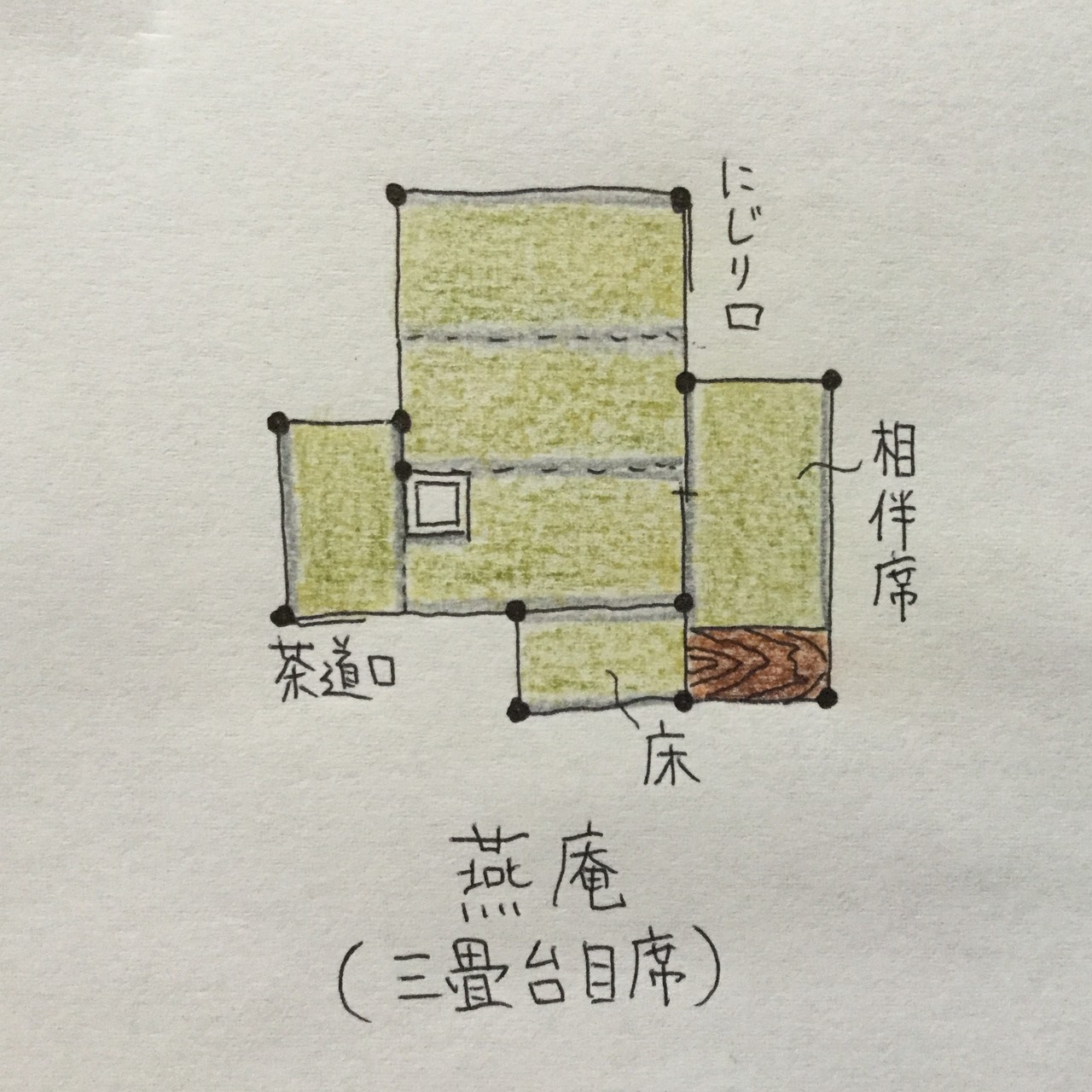
- 遠州(えんしゅう)reintroduced 書院 feel, for example in 密庵(みつあん)
- 有楽(うらく)created 如庵(じょあん)
→ Nobody continued 利休's style
坪ノ内 (CQ81)
- Walled space in front of 躙口(にじり ぐち), which serves as a interim space between mundane outside world and tearoom. Later, the 路地(ろじ)would play this role