This is an old revision of the document!
- Named for the hot stone Zen monks place in their robes to ward off hunger pangs.
- CNY's 懐石 developed from the 本膳料理(ほんぜん)(elaborate meal for high social strata) and 精進料理(しょうじん)(vegetarian Zen monks), because it was related to both.
- CQ78 notes that most meal traditions around the world have the host and guest eat together, but in CNY, the host does the serving.
利休:Entertain with farmer's soup and seasoned shrimp; it suffices for the host to do the serving.
- Jōō said: no more 一汁三菜(いち じゅう さん さい), one soup and three sides, even for a guest of honour. That means: one soup, some fresh ingredients in vinegar, something in a shallow dish, and something broiled.
- And keep it simple, make with what you have:
- 利休's son 道安(どうあん) invites him for tea in winter; he get's very excited as he see's someone in the snow covered vegetable garden, thinking it would be his son picking vegetables for the meal. But instead, his son serves him a rarity from far away; so he was disappointed. (CG56, 78)
- In the Nampō Roku, it is even stated that the meal should be vegetarian.
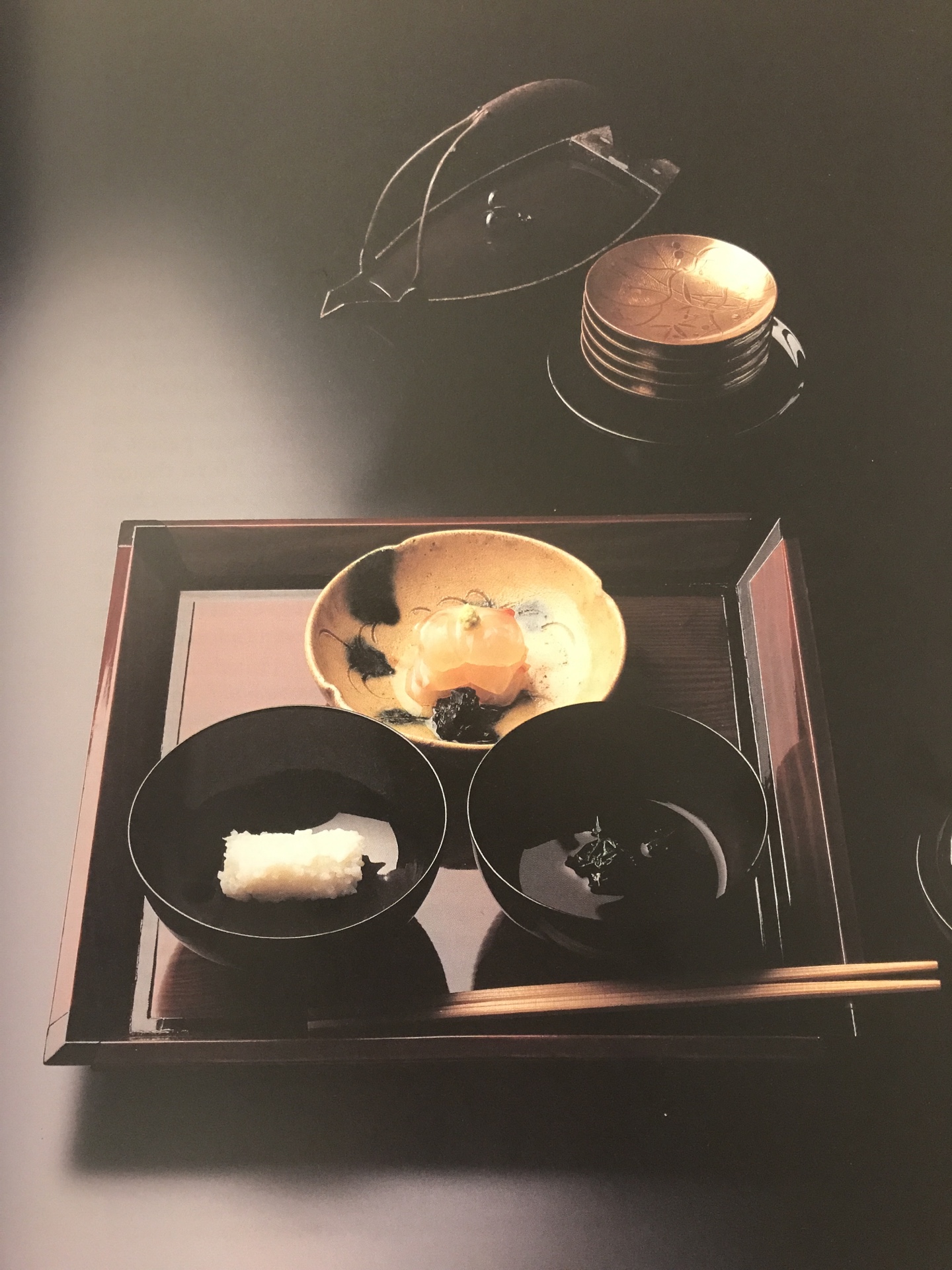
- 利休 adhered pretty much to 一汁三菜.
- 織部(おりべ)after 利休's death wabified 懐石 even more, being more strict about 一汁三菜, forbidding also a second round of trays. However, other people after 利休 went back to a more impressive food serving during tea gatherings.