This is an old revision of the document!
CQ51 and CQ52 have a great overview: conceptually, all 棚 are baby-台子; and as such, we have four categories:
- 台子 (including the 長板)
- 小棚, which is really what we usually mean by 棚 today.
- 仕付棚(しつけ), which are permanently affixed
History
- 台子 brought from China to Japan in 1267 by a monk together with a 皆具 set; and this came to be used for preparing tea. At first in a separate room, then, around 1450, in front of the guests; still with the 台子.
- Jōō was then the first to deviate from the 台子 with the use of the 袋棚(ふくろ), a staggered 大棚 inspired by 香道.
- 棚 are not used in the small room, or in large rooms where for example the 風炉 is on the ふみこみ畳, or if the 炉 is in the host's 畳.
Principles
- The 薄茶器 is 陽, the 柄杓 is 陰 (and I suppose the 蓋置, as well). In most cases, this means that the 柄杓 is above the 薄茶器 (on two-tiered shelves). Exceptions are the 更好棚 and the 千歳棚.
- If they are on the same level, the 薄茶器 is always right of the 柄杓. If it is in the middle of the self, the latter is placed diagonally (and the 蓋置 left in front of it).
- 蜻蛉荘り is used for square or round shelves: Here, the 柄杓 and 蓋置 are place like in the beginning (入荘り), and the 薄茶器 is placed to the R of the 柄杓.
- For long shelves, the 薄茶器 is in the very middle, with the 柄杓 and 蓋置 forming their own group farther away from it.
List
| 好み | 棚 | 📸 |
|---|---|---|
| Jōō (-I) | 紹鴎棚 |  |
| Rikyū | 志野棚(しの) |  |
| Rikyū | よし |  |
| Rikyū | 旅箪笥 |  |
| Sotan (III) | mulberry 及台子 | |
| Sotan (III) | 及台子 lacquered green with red edges (爪紅) | |
| Sotan (III) | 高麗台子 | |
| Senso (IV) | 桑小卓 |  |
| Itto (VIII) | 老松 台子 | |
| Nintokusai (X) | ゆがお (Moonflower) 台子 | |
| Gengensai (XI) | 更好棚 |  |
| Gengensai (XI) | 寒雲棚(かんうん) | |
| Ennosai (XIII) | 吉野. Special, because it displays the 帛紗 on the top shelf! |  |
| Ennosai (XIII) | 老松台子 | |
| Tantansai (XIV) | 徒然 |  |
| Tantansai (XIV) | Ryusei |  |
| Tantansai (XIV) | Yachiyo |  |
| Tantansai (XIV) | 瓢, can be used with or without the bottom board. |  |
Others that I haven't yet listed above:
- 三友棚
点前
- 片口 if the 棚 has 3 legs or fewer; where you don't need to remove the 水指
- こしぐろやかん for 棚 with 4 legs
- Generally, the 茶杓, when resting on the 棗(なつめ)or 茶入, never protrudes into the space of the 棚. This dictates the distance of the 茶入 etc. from the 棚. This is also true for boards as in 中置き(なかおき), for example.
- When 棚 is used, we don't use a bamboo ふたおき.
- When finishing, take 柄酌, hold with L, then turn R away from you to hold from below, and place on 棚. Make sure it's not sitting on the edge of the 棚, but within. For 濃茶, this happens after putting out the items for 拝見, but 薄茶 before.
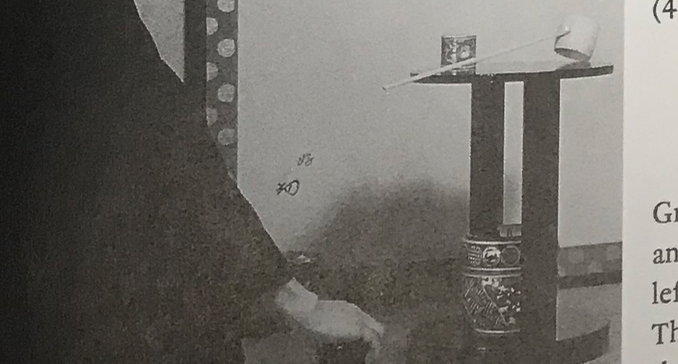
- Then take 蓋置き on L, R on knee, and shift in front of 棚.
- Also, when you start with the 棗 on the 棚, something needs to change before you go. Either take it with you, or put it on the shelf differently.
炭 炉
- Entering and unpacking
- Depending on 棚, 羽 and 香合 are on it already. In that case, shift in front, put 羽 down in front of it, pick up 香合 and then with both shift to face the 炉. Put down 羽 next to 炭斗, and 香合. Then 鐶, then 火箸.
- Otherwise, enter with 炭斗 and place it next to the 炉; then unpack: 羽, 鐶, 火箸 and then 香合.
- Close the lid with the 帛紗
- When moving 釜, shift to face 棚 and move it to its left side.
薄茶 炉
- 水指 lid with R, L (for opening during tea, and when filling it)
- Closing: first 棗 (one hand), then 茶碗 (two hands)
- For 拝見: Shift to 0° to pick up 棗, clean it at 90°, then to 45° to get 茶杓 and put it down from there.
- After 拝見, shift in front of 棚, place 茶杓 on 水指 lid if it's lacquered, or on the 棚 if it's ceramic (?), put 棗 on 棚, and just go out with the 茶杓
総荘
- You can display the 茶碗 and 棗 on practically every shelf (except for the だんす).
- If you do, you clean the 茶碗 as in 入子点
- However, unlike 入子点, you come in with the 水次 and you don't decorate the 棚 with the 帛紗.